Showing posts with label gut allergies. Show all posts

Wednesday, 9 April 2014

Main Meals for Kids

I find my biggest challenge is providing a balanced week day menu for my children after school. Their school will not provide them with a hot lunch, so I make up a cold lunch daily for them both. Their older brother is "only" gluten free which is slightly easier, and his High School provide him with a nutritious hot meal every day which is a MASSIVE help to me.


Like many other children with food allergies, my twins have some swallowing issues. Reflux alone usually means "sticky" food is harder to swallow, and really dry food can stick at the back of the throat. This is because reflux often desensitises that area making the swallow reflex slightly delayed - usually not much of an issue but in persistent reflux it can become a problem.

Our daughter suffers particularly with this and has to sit upright, pace herself and is very good now (at age 8) in knowing what she can and cannot manage to eat without risking choking.

And, like almost ALL children, those with allergies will still have likes and dislikes, favourites and food they wouldn't touch with the proverbial bargepole. Lastly, children with food related disorders and health conditions almost always have an overly strong emotional relationship with food. It *really* matters to them, it is often a bigger focus than maybe it should be, and they care deeply about what they can and will eat. (And what they can't!) So catering for this group can be akin to stumbling blindly through a minefield!


It's therefore even less acceptable to fob them off with the same meal several days a week (unless there are other reasons for doing so, we did it when weaning our son from tube feeds so I would never condemn anyone!) and given their dietary restrictions, nutritional content is absolutely KEY. I recently wrote about the Free From Food industry and whilst it is fine to use ready meals occasionally, most are high in salt and sugar to add flavour. You simply cannot beat cooking from scratch -and it really isn't difficult.

So here is a sample week-day meal planner for primary aged children, which you can rotate as necessary. It relies on several staples which you can easily keep in your freezer and a couple of half days (or evenings) of batch cooking. I've tried to exclude recipes which have the main allergens in, and the majority are meals you can cook in advance and freeze if desired.

Wednesday, 19 March 2014

An explanation of Food Allergies for Children

Healthy Eating - What it means for us

Dorothy's friends Katherine and Alfie are eight years old. They suffer from food allergies, in their case “gut allergies” called non IgE allergies which you can’t test for.

IgE allergies are the ones which bring an instant reaction, and extreme forms can cause anaphylaxis.
Do you know anyone who carries an Epipen? They contain medicine for that sort of allergy. You can test for those - which makes identifying your trigger foods a little easier, although food allergies are never easy!


"There are different types of food allergies. We have Eosinophilic Disease, when the body gets confused and thinks some foods are like germs and need attacking. The problem is this attack can end up hurting your body too! Eating those foods make your throat, tummy or bowel red and sore and stops them working properly. If you are not careful then things we all take for granted like eating, swallowing and digesting food don’t happen properly. Going to the toilet can be painful, take a long time and be really difficult. Like any other food allergy you must stop eating the food your body is reacting to.

Some people react in a quick, dangerous way to foods. This can be life threatening. Others react more slowly but the long term effect can be very serious. All our bodies like to be cared for, letting them get red, sore and swollen for long periods of time can damage them. Our bodies work best when they are properly cared for. We all try and look after our teeth by not eating too many sweets! If you have a food allergy you look after your body by avoiding those foods your body reacts to.

Sometimes that means you cannot eat foods which have important things in them for growing. That can mean you need to find those important things in other foods, or in a special formula drink, and take medicines to keep healthy."

Food still needs to be fun though - Katherine and Alfie do lots of baking and cooking with their mum. You can substitute most foods to make delicious recipes.


Katherine says "Getting enough energy is really important - we use a lot of it in school! So sometimes food you might think is less healthy is just right for us! Healthy Eating is really important. It is about looking after your body. But most of all it is about eating in a way to take care of your own body in the best way possible for you."

Want more information on food allergies? 
For “classic” IgE food allergies Our Allergy Adventures is a great site for kids. Lots of activities and useful child-friendly information.
For general info on allergies for kids www.allergykids.co.uk/
Or if your parents want to read more about allergies and intolerances, or more specifically Gut Allergies.

Sunday, 16 February 2014

Why I set up the Recipe Resource. (The long version!!)

Inspired by Vicki's Guest Post for me, about her reasons for starting her Blog I realised I had never really given mine. So here they are - the long version...

The first few years of life are a time when most children gain weight and grow much more rapidly than they will later on, and the first year especially so. Having already had two babies with moderate reflux I expected our twins to suffer too, I felt I had “been there” and bought the proverbial T Shirt, even having two with reflux need not be too challenging, surely? How wrong can you be?!

Friday, 13 September 2013

Gut Allergies - and why we NEED awareness and understanding

On the support forum I run and another I co run I am constantly writing the same replies to the same questions. Time and again the same questions come up - a child/baby with reflux who the doctors say they will "always" outgrow by 6 months fails to do so. Then 12 months comes, but weaning is problematic and the child appears to be reacting adversely to Cows Milk, Wheat and other foods. Tests are negative and parents are fobbed off and made to feel they are blowing symptoms out of proportion.

Many doctors perform allergy tests, for gut allergies which cannot be tested for, and then promptly dismiss the case because there is nothing for them to do. They may perform a pH study, previously the "Gold Standard" reflux test which cannot detect alkaline/allergic reflux or pressure changes in the bowel and possible allergic bowel inflammation is never picked up. Few hospitals can offer an impedance study, fewer still know how to interpret the results adequately. So because they don't have a clear answer many doctors are dismissive.
You would be horrified how often this happens, I hear about it all the time.

Some carry out endoscopies but stop above the stomach and the results are clear - so there must be "nothing really wrong". All too often the spotlight is then turned on the mother who "must" be neurotic, over-reporting symptoms, depressed perhaps? But lack of understanding or explanation is NEVER an excuse for being dismissive and accusatory. Ignorance does not excuse such actions - or have we not come so far from the Witch hunts of the seventeenth century? I have no explanation does not equal "someone is to blame". Even the most sympathetic doctors run out of ideas when tests come back clear.

I'm not sure what alarms me most - that there is still so little understanding amongst health professionals about gut allergies and their impact on the full length of the GI tract and elsewhere, or the stark truth that gut allergies in infants and children are occurring in epidemic proportions.

For us, we struggled for years with all of the above until we were referred to GOSH who FINALLY performed scopes below the stomach. Bingo. Serious bowel inflammation, duodenal ulcers and other damage. Everything above the stomach had looked near perfect, ph studies had been reasonably  acceptable... and skin prick tests negative for the most part. Dealing with an emergent disease like EGID, or symptoms which doctors have yet to put together and diagnose is a massively uphill slog, and unless you have the strength of Goliath, the stubbornness of Thatcher and the unwavering focus of Churchill you don't stand a chance.

But aside from all this the bigger question is being neglected - WHY are SO many children suffering severe gut allergies? Why does our youngest generation suffer food protein allergies on epidemic proportions? Because seriously, that's what we are looking at here. At the twins' school, six children have diagnoses of EGID now. SIX. And of those I have helped support on forums over the years, friends I have made, I know about 50 children with gut allergies impacting seriously on their lives. Our Consultant at GOSH asked my daughter and I to appear on TV for the 100th Anniversary of GOSH to spotlight the Gastro department and highlight the escalating number of children suffering from gut allergies. He used the word epidemic then, and it was no exaggeration.

But it seems no one is doing the Maths, taking the data and analysing it. No one is sending out the information and any new results to local hospitals, explaining how gut allergies work, sharing new knowledge. Our NHS is functioning in crisis mode and only dealing with the here and no, the in-my-face-and-un-ignorable crisis/case I have to address. But at some point, SOMEONE or some group is going to HAVE to address this massive issue and start looking at why our children cannot eat. At why their digestive systems are no longer happy in the twenty first century first-world environment we are bringing them up in.


Until then, I will continue to post the same answers, day after day, and share the information I have learned over the years, the information GOSH share through their APG Study Days for Parents and Professionals because until *everyone* understands what a gut allergy IS (and it is NOT an intolerance!!)  there is no hope of a consistent, helpful approach for parents in the nightmare that is feeding and caring for a child whose gut cannot perform the basic functions it was intended to AS it was intended to. And I, for one, cannot live without hope. My children and all the other children I know suffering with gut allergies and related diseases deserve better. FAR better.


Saturday, 27 October 2012

"Constipation", Motility and Movicol

When you think of constipation, it is usually not only the inability to pass stool, but the passing of very hard, dry stool. This is indeed true constipation, but the term is frequently used to include all conditions where someone is unable to poo. Constipation is a very common problem for children and most of the time constipation does indeed mean passing hard stools, with difficulty, less frequently than normal. Unfortunately heading to a GP and explaining that your child is constipated without any details can cause considerable unintended complications, with potentially inappropriate medication prescribed which can have long term unwanted effects. Gut motility is central to treatment and the term "constipation" can be very misleading.

"Overflow" (loose stool flowing around the trapped hard stool) is often seen early in treatment regimes for constipation, when it appears laxatives have cleared the bowel out, but unless they are continued for approximately the same length of time the person has been constipated the bowel does not clear fully and will not contract back to enable it to function properly. Regular soiling because of overflow is often mistaken for runny diarrhoea but may indicate that a child has bad constipation with impaction (a blockage of stools/faeces).

As well as classic constipation, where your child might be straining to pass infrequent hard, dry stool there is such a thing as "slow transit" constipation, and there is dysmotility. In slow transit constipation relatively normal stool is passed, with otherwise normal - but slow- motility. There may or may not be straining on defecation - I will come to that later. There is also a condition known as dysmotility, which is slightly different.  Treatment differs for all three types, or at least should do for best outcome.

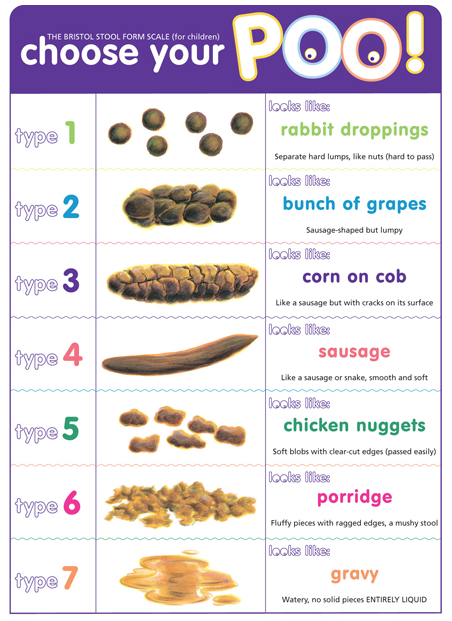
The Bristol Stool Chart for Children
Or you could make your own, like we did ;) Young children love toilet humour and humour is great for reducing tension and anxiety. Our own chart included "Jacket Potato Poo" and "Volcano Poo" amongst others, I will trade laughing over stress and anxiety any day.


The child who is presenting with rabbit dropping type stool or type 1 on the chart above would clearly benefit from more water in their stool. They may well not be drinking enough, and checking this is an excellent place to start. This type of constipation can also be a direct response to food/gut allergies but the latter is more likely to slow motility than affect the water content in the stool. That my personal observation though, I am happy to be corrected on that one!

Movicol (or Miralax in the USA) is an osmotic laxative and a great drug for short term use in such cases (Type 1 stool) . It contains a plastic derivative that is used in disposable nappies (macrogol polyethylene glycol '3350) and just like the child who sits in a paddling pool with a nappy on, it swells with water. (try leaving a few sachets mixed overnight and see how it turns by morning.) This obviously DOES increase the water content..... but as you can see it will also increase stool volume.

My big concern is that this drug is the routine first line medication for childhood constipation. Have you checked out the racks of frequently used prescription meds in Boots? Movicol is probably taking up at least a whole round shelf.... and every GP in the country seems to have a Movicol sponsored sticky notes pad. Great marketing..... but this drug is really not ideal if you are NOT dealing with classic constipation.

Slow transit constipation can actually result from chronic untreated/poorly or inadequately treated classic constipation. The bowel can become stretched as hard stool collects as bowel peristalsis struggles to move it along. In this scenario Movicol can be helpful to soften the stool but it will increase the stool volume in high doses, thus giving the bowel even more work to do at a time it is struggling. It is important to explain to your Dr about your child's stool consistency and normal pattern of passing stool, because if you are straying into the slow transit category Movicol use needs some caution. This is especially important in young children because there is a balancing act between being as gentle as possible, clearing the bowel effectively to avoid compounding the problem and ensuring you are not adding to the problem if motility is an issue.

Slow transit will often happen in an inflamed bowel, which cannot contract and relax as effectively as it might do despite stool being a normal consistency. I have explained how local allergic responses to food in the gut can impact on bowel motility here , in some there is a rapid response, if my youngest son ingested anything different as a baby his gut seemed to "switch off" whereas his twin sister would have a slower response, making it much more difficult to work out the trigger!

So the slow movement might be due to true constipation or it might be due to bowel inflammation (or other disease) but (and I had a recent discussion at GOS with our motility consultant about this) it is important to know as far as possible what you are treating, as high fibre/volume is not beneficial for a bowel which is struggling and when you are not dealing with a hard stool issue.

Dysmotility is slightly different. There are many different causes, and there are some excellent explanations here . It might involve a muscle problem or a nerve problem, and sadly the latter can happen as a direct result of chronic constipation. Muscle and nerve problems can be picked up in a test called Colonic Manometry, a very useful (although only available at GOS in this country at present) test to determine nerve and muscle function in the colon.

This is one of the problems my son is dealing with. As well as having slow transit due to inflammation (EGID) he has nerve damage in his colon as a result from years of having an inflamed and overloaded bowel. We were at the point where he needed the highest dose of the one of the strongest stimulant laxatives (sodium picosulphate) and was still only able to "go" approximately every 9-10 days, at which point the volume was so enormous that he would block the toilet frequently.  It's not exactly rocket science when it comes to understanding how a dysmotile bowel or one with slower motility might struggle with large doses of fibre and or Movicol. The 8-12 sachets per day we had to give for over two years appeared to us to be contributing to, not helping the problem. After careful discussion with his doctors we decided to stop the Movicol..... and held our breath. He started going almost every day - still requiring the stimulant laxative - which was the most fabulous step forward. For us, Movicol was NOT the answer, and I wished I had understood the difference between transit problems and constipation a lot earlier. Our son now has an overly large (diameter) and far longer colon than usual, as a result of years of overloading it. This has caused nerve damage (which may heal over time) which is probably more severe than it would have been had we addressed the motility issues a lot earlier. My youngest son has EGID, is more complicated than "normal" but nonetheless it took far too long to determine the cause of his "constipation" and get him on appropriate medication.

Hirschsprung’s Disease is an uncommon motility problem marked by an absence of nerve cells in the walls of the rectum or colon. This condition is present at birth and can be hereditary. Without the necessary nerve cells, intestinal contractions cannot occur, and stool remains trapped in the large intestine, called obstruction. Not passing meconium, constipation, and vomiting are common symptoms. Treatment is primarily surgical, with the removal of affected tissue from the bowel.

Lastly there is the outlet obstruction type of constipation, where the stool consistency is not the issue, the motility is (initially) not the issue but the child has to strain and strain. This can be for different reasons. In the allergic gut, inflammation of the anal sphincter will inflame it and cause it to rest at a much higher pressure than normal. To pass stool, the sphincter pressure must be equalled from the other side, to cause it to relax. A sphincter at a very high pressure will require a large volume of stool (of whatever consistency) to be present to permit relaxation. The child will strain and strain and eventually pass a large volume of stool which might even be liquid but which cannot be passed until the volume creates sufficient pressure. Unfortunately this becomes a vicious circle, because the higher than normal volume needed eventually stretches the rectum and it becomes looser, so larger volume is needed to equalise the pressure and so on. Anorectal manometry is really useful for testing this potential problem. In the USA Botox has successfully been used to treat this problem but identifying the  inflammatory triggers and treating the inflammation is the way forward.

Young children can also have functional constipation, such as withholding stool which should also be considered in a child of toilet training age. Whilst a behavioural issue it can cause longer term problems as you will work out from the info above. Stool collecting in any part of the colon over a long period is a potential problem and you should speak with your Health Visitor or GP.

Constipation of any sort will often impact on the entire GI tract. If one bit of the pipe functions less well, the rest will know about it. Reflux will be worse, abdominal pain is possible, reduced appetite with a feeling of fullness, and even retching and vomiting. This is very obvious in infants whose smaller bodies exhibit rapidly worsening reflux should they already suffer, and one reason why feed thickeners and so called "hungry baby" milks can make things so much worse. Digestion of solids and thickened milks takes longer, making the baby feel fuller for longer but allowing the stomach contents more time to reflux back. Hungry Baby Milk has no nutritional or calorific value over and above normal formula and is therefore only designed to make babies tummies feel fuller for longer presumably for the benefit of the parents, with potential problem resulting from delayed digestion for babies who already suffer with reflux.

If you are dealing with more severe motility problems there is an excellent article here in the Complex Child ezine.

As you can see, there is far more to "constipation" than needing to add water to the stool. It is important to have some idea of current stool consistency compared to your child's "normal" if consulting a doctor about it, and to initiate a discussion as to whether your child is going less frequently, having trouble passing the stool, and what that stool consistency is when coupled with those symptoms rather than merely reporting "constipation" and leaving the surgery with a box of Movicol sachets. There is a growing body of parents (and thankfully, doctors) who are concerned about the overuse and misuse of this apparently benign drug which I sincerely hope will avoid others going through some of the problems we have suffered, and still suffer today.

There is some excellent information here on constipation in children. Remember, Constipation can be very common in young children and occur for no obvious reason. (idiopathic) The information on this Blog is aimed at those parents managing children with underlying issues, such as allergic, inflammatory gut issues because that is the background I have, but in all cases of constipation in children careful note needs to be taken of the circumstances and symptoms.

DISCLAIMER - I am not a doctor, the information above I have ben told, read and learned over the years. The opinions are not only my own, but it must be stressed that this is a Blog not a medical document and whilst knowledge and opinion is useful you must follow the advice of your/your child's doctor. By all means discuss the above, I have carefully referenced the information but I am not medically trained.


Thursday, 25 October 2012

All about Allergies, immunity and Autoimmune Conditions

When most of us think of the word "allergy" we are thinking of a systemic immune response, or at least an immediate and visible reaction. For myself as a child, allergies meant allergic rhinitis - streaming eyes, runny nose, and atopic reactions (rashes, usually itchy) to almost everything it seemed. My bedroom floor was regularly hoovered, as were the curtains and the bedding was washed every few days. My teddy lived in the freezer during the day for some time too to help eradicate the house dust mites I was so allergic to. I was on Beconase inhalers for years and we probably should have taken out shares in Piriton... However there are different kinds of allergic responses.

IgE MEDIATED RESPONSES
The above are all IgE mediated responses. True allergies, and allergies you can test for. IgE is an immunoglobulin. An immunoglobulin is "any of a class of proteins present in the serum and cells of the immune system, that function as antibodies".  There are five subclasses of immunoglobulins, explained here far better than I could. DO read that link, it's the single best source I have found for non medics to explain your immune system and how it is classified.

IgE responses can be tested for - in Skin Prick Tests, and in RAST blood tests. The former have to be properly done to be accurate and reliable - we spent two years carting around an epipen for our second son who was allegedly allergic to peanuts - only to be retested a couple of years later (properly) and be told this was in fact rubbish. (Whilst some allergies can be outgrown, this is almost never the case with an IgE reaction to peanuts.) RAST blood tests are interesting, because they cannot in fact measure the severity of the reaction, the higher the number the higher the exposure rather than severity of response, so an older person would be expected to have a higher count.

NON IgE MEDIATED RESPONSES
You may think that a non IgE response would have to be what is termed an intolerance, but you would be wrong- along with an alarming number of health professionals I have encountered! An intolerance does not involve the immune system at all. A non IgE allergy is also known as a Type IV sensitivity, or cell mediated response. It is a local reaction and is rarely possible to test for. Gut allergies are delayed hypersensitivities, which is why food allergies are so traumatic and difficult to manage, requiring strict exclusion diets to determine responses to possible triggers. Imagine an eczema reaction in the gut - it's a localised response to an allergen (or a false allergen which the body responds inappropriately to) and causes a localised problem - no anaphylaxis, no outside response (although IgE responses are often present in addition in those with gut allergies) and is very difficult to diagnose.
Gut allergies are always responses to proteins, protein molecules are those the immune system responds to. Problems with carbohydrates/sugars such as lactose intolerance are not (as far as I know!) allergies.

GUT INFLAMMATION
Now imagine that patch of inflamed, irritated gastrointestinal tract - if your skin has a patch of eczema it is less supple, less flexible, cannot function at its best. Gut tissue is the same - it cannot function as well as it becomes inflamed. Inflammation ANYWHERE in the GI tract can cause symptoms anywhere else along its length. So, you can have reflux (which is only ever a symptom, be it from food allergy, obesity, muscle disease, ligament laxity, developmental delay etc) constipation, vomiting, diarrhoea, trapped wind, acute pain, chronic pain, bloating, wind - all from gut inflammation due to a localised allergic response. All too often I hear of children and adults with reflux symptoms, who have an upper endoscopy ("scope" where a camera is used to look down your throat as far as your stomach, and sometimes down to the small intestine below but only a small way down.) and a ph study which is negative and they are told there is no inflammation, no problem. It's happened to us too, my daughter was fobbed off for years until someone bothered to look lower and found inflammation and ulceration, causing the reflux further up. Bowel inflammation can, and does cause reflux. There are often other clues but sometimes it is that simple.

APPROPRIATE CARE
What is so concerning is the difficulty so many parents are having in getting appropriate care for children with clear reactions to food. Any parent with a child suffering from food allergies will tell you how their child reacts - yet if skin prick tests and RAST tests are negative many doctors come to the conclusion there cannot possibly be an immune response. Some doctors prescribe patch testing, which does indeed show delayed responses, but only on the skin. If it is only your gut tissues which is reacting, they are not going to be particularly helpful.

Another useful test is an serum IgA blood test. Immunoglobulin A is the major antibody found in the membranes of the respiratory and gastrointestinal tract. The second most common immunoglobulin in the human body, IgA can also be found in tears, saliva, mucus, and colostrums. IgA is one of the most important immonoglobulins in local immunity. Interestingly those with gut allergies often have low IgA levels, and in those who outgrow their gut allergies their IgA levels often rise approximately 6 months before such improvement become obvious when closely monitored. This is another reason why the antibiotic Azithromycin is so successful as an anti inflammatory agent in the gut, because of its role in the absence of IgA.

REFLUX and GUT INFLAMMATION
There is a huge surge in babies with reflux in the West, which is often due to gut allergies such as Cows Milk Protein allergy or reactions to other food proteins. It is often outgrown by the age of one but in those whom it persists into childhood underlying causes need to be investigated - any paediatrician should tell you that. The gold standard test for reflux used to be a ph study, measuring the ph at the top of the stomach. However, reflux caused by bowel inflammation is unlikely to be acidic unless the stomach contents at that time are acidic! Reflux caused by bowel inflammation is more likely to be alkaline, and shows up best using an impedance study or pressure test, used in conjunction with a ph probe. Gut inflammation will reduce gut functionality and therefore cause pressure changes along the GI tract.

No one is exactly sure why there is almost an epidemic of gut inflammation in the West. Many will tell you it is the overuse of antibiotics, the increasing prevalence of GM foods, over production , pesticides, chemicals etc but the truth is we just don't know. One thing is certain though that gut allergies are on the rise. In America there has been a surge in the number of diagnosed Coeliac Disease cases - interestingly Coeliac is another delayed hypersensitivity, as is Chrohn's Disease. Eosinophilic Disease is also thought to fit into this category which makes it so very difficult to treat and manage.

FOOD ALLERGIES AND BEHAVIOUR
Until quite recently there was little understanding of the way gut allergies worked. Recent research at Great Ormond Street has shown how neurotransmitters in the gut sit next to mast cells which are responsible for these local gut reactions. As these mast cells degranulate they release huge quantities of toxins which cause a local pain feedback cycle. They are also soaked up by the neurotransmitters and enter the central nervous system. This is thought to be how food allergic reactions cause the behavioural issues we often see in children with food allergies and could also explain why the casein and gluten free diet for Autism might just work for some children, who in fact display ASD type behaviours due to delayed gut hypersensitivities.

VACCINATIONS
Local gut reactions also cause an increase in histamine levels which make the gut wall more permeable. Anyone heard of Leaky Gut Syndrome? Something I thought highly "alternative" and improbable until I was immersed unwillingly into the world of gut allergies. What is more concerning is recent GOS research which is supporting the theory that the blood brain barrier is permeable (as is the gut) when local immune activity is present. Teething can also precipitate this permeability by raising histamine levels. There is in fact current speculation as to whether a highly allergic child - whether IgE or non IgE  - and/or one who is actively teething should have their vaccines postponed/delayed. This is similar to the theory postulated by Andrew Wakefield, whose totally flawed study left him hung out to dry but which buried the real message that timing is actually important with vaccination and that the links between the gut, Autism and vaccination might well have more to do with histamine and gut permeability than multiple vaccination programmes.

AUTOIMMUNE DISEASES
Lastly what i find particularly interesting coming from an EGID perspective is that several Autoimmune diseases are also Type IV hypersensitivites. Hashimoto's Thyroid Disease (which I suffer from) Diabetes Type 1, Arthritis... all the same type of reaction by the body. There are extremely strong links between gut allergies, immune profiles and autoimmune diseases. My children also have low IgM and IgG levels - again, common in those with autoimmune disease, but also caused by gut inflammatory conditions!

So despite being non-IgE, impossible to test for allergies, the immune profile of these localised, delayed hypersensitivities is perhaps more profound than the more obvious, recognisable IgE responses we are all more familiar with. I think it's about time the medical profession sat up and took notice of the autoimmune time bomb in the West and the surge in gut allergies - REAL food allergies so many people (and particularly so many children) suffer from ARE relevant, and health professionals in the twenty first century have a responsibility to take them very seriously indeed.


DISCLAIMER - I am not a doctor, the information above I have ben told, read and learned over the years. The opinions are not only my own, but it must be stressed that this is a Blog not a medical document and whilst knowledge and opinion is useful you must follow the advice of your/your child's doctor. By all means discuss the above, I have carefully referenced the information but I am not medically trained. I support and endorse vaccination programmes - having children with reduced immunity I know the importance of herd immunity and prevention of disease. I always endeavour to research issues affecting our family however and take each intervention as an individual case. 
Related Posts Plugin for WordPress, Blogger...