Showing posts with label NICE guidelines. Show all posts

Friday, 4 November 2016

Slow hand clap to the Food Standards Agency...

You know that popular meme of someone staring at a computer late into the night? Can't go to bed because "someone is wrong on the internet"? Quite appropriate..... except it's not bedtime and I *should* be focussing on the kids' homework, the child who is on the loo (he won't be going anywhere for around 45 minutes though, but then that's non IgE allergies for you...) and the fact that after the week I've had it really *is* Wine O'Clock and this could wait.

Except it can't.      

Myself and many, many others, from Fabed, National Allergy Strategy Group, Adam Fox and his team of paediatric Allergists and Allergy nurses, based at St Thomas's hospital, numerous paediatric gastroenterologists here and abroad plus parents dealing with the reality of life with non IgE food allergies have spent years campaigning to increase awareness and understanding amongst health professionals, teachers and communities that food allergy is not confined to an acute IgE episode. 

I wrote about the desperate need for increased awareness here . You would be *stunned* to know how many parents I know who have encountered health professionals who still simply do not understand how delayed allergic responses work, what FPIES and EGID are, or how cell mediated gut allergic responses cannot be tested for. The numbers of families damaged by poor or indifferent care, or those with little support for children at school, and even those hounded by Social Services because community professionals just don't "get" non Ige allergies. I've attended meetings for the All Party Group on Allergy before, and there are increasing numbers of people appreciating these issues - then the FSA railroads over all recent work in one ridiculous picture.


Yup, they've attempted to differentiate between food allergies and intolerances by reaction time, not even mentioning non IgE allergies. There is so much wrong with this I scarcely know where to start. Their sole defence is that they are trying to "simplify" things. But that's like listing a simplified list of political parties in Britain as Labour and the Conservatives. It's not simple, it's simply WRONG. it helps no one and subtley erodes the hard-won gains made by those of us trying to bring hope for our children.

If my daughter has half a slice of gluten free bread with egg in she becomes unwell several hours later and the response lasts days. If she has the tiniest amount of soya the entire response process which includes soiling and bleeding lasts up to a month. Just where on that chart would she fit? Or her twin brother who has long term bowel damage from non IgE symptoms and narrowly escaped surgical intervention years ago, whose non IgE allergic gut reaction to wheat in particular accumulates over days and weeks.

This isn't a simplified chart, it's an exclusive one, which excludes a significant proportion of those with food allergies. 

We have to contend with the media spouting about the middle class disease that is food allergies, who never stop to think of the opportunity such an editorial presents for education, for explanation and enlightenment. I've contributed myself as a lay person to publications on allergy, which fail to accurately detail non IgE food allergies. Yet still the ignorance persists.

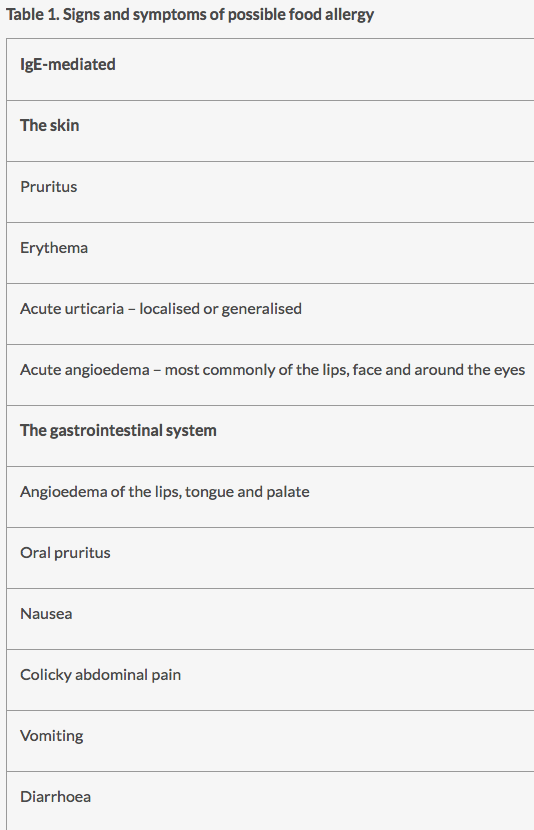
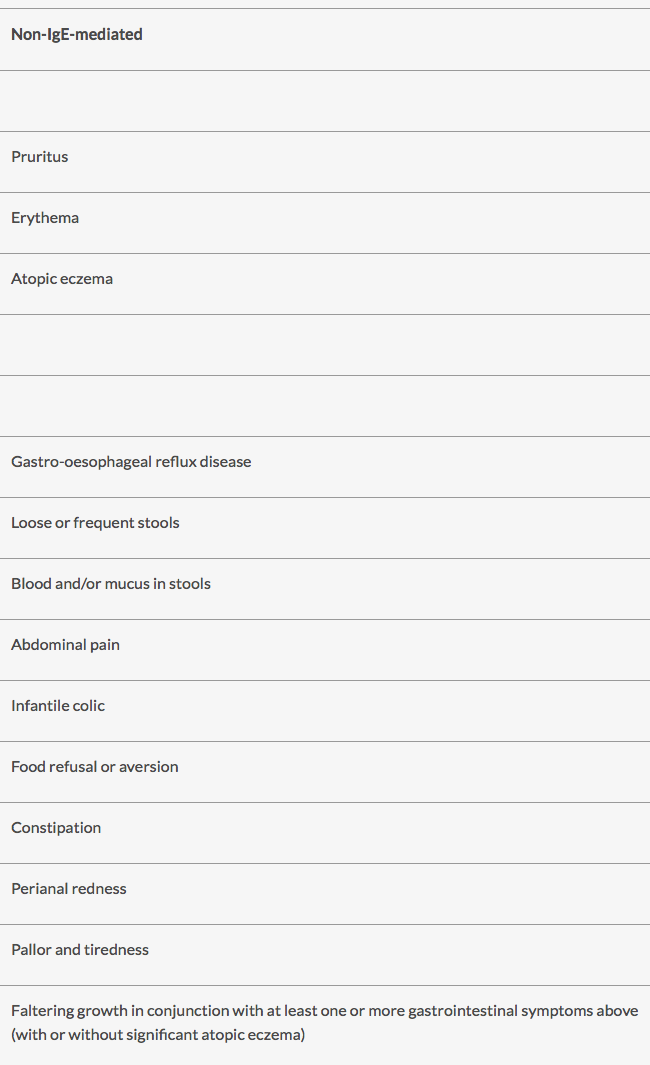
It's not even particularly new information. The National Institute for Clinical Excellence (NICE) has had their own chart since February 2011, which is here. THEIR chart is reproduced below. It's a bit small, but that's because you just cannot over simplify this, at least not in the way the FSA are attempting to.


So what *are* non-IgE Allergies?

Non IgE food allergies DO involve the immune system, but locally, in the gut. It is a cell mediated response rather than a systemic, whole body reaction. It isn't immediately life threatening, but the long term impact ca be significant. t is a local reaction and is rarely possible to test for. Gut allergies are often delayed, which is why food allergies are so traumatic and difficult to manage, requiring strict exclusion diets to determine responses to possible triggers. Imagine an eczema reaction in the gut - it's a localised response to an allergen (or a false allergen which the body responds inappropriately to) and causes a localised problem - no anaphylaxis, no outside response (although IgE responses are often present in addition in those with gut allergies) and is very difficult to diagnose. Wikipedia actually explains this very well here . Like I said, it isn't new, and there is NO excuse for the FSA being so slapdash.

So my advice to them is to get with the programme. Work IN the 21st Century, add a third column and revise your information. Or delete it completely, because quite honestly, you've just shown yourself to be out of date, out of touch and under-informed. Unfortunately though, that picture has probably done more damage than the impact its had on your reputation.  


SaveSave

Friday, 5 June 2015

Not waving, but drowning.

Both The Times and The Telegraph are today running stories on concern over middle class children being starved due to misplaced parental concern over food allergies. Clearly this article has been shared between both newspapers but what concerns me is the complete lack of medical advice or concrete information on the subject amongst the sweeping accusations made. Whilst loosely based on the collaborative report in Sense About Science  on Allergy, it's just another scaremongering article which belongs in the gutter press and helps no one. Indeed, the original report, whilst more balanced, still neglects to described the non IgE food allergies so many - including my family - suffer from.

I'm sure there is some genuine cause for concern, and it's true to say that more affluent parents are more likely to fall foul of the latest food fad since a)they have more money to spend on their children and therefore have greater choice and b) possibly more time to consider the options. (A child in my daughter's class is "allergic" to sandwiches, but eats cakes and biscuits with wheat in...) Certainly middle class tooth decay is no myth, as one comedian observed in his comment on raisins being "middle class crack for kids" our obsession with meeting the "Five a Day" guidelines led many to unwittingly feed their children frequent fruit snacks which were so full of sugar that the incidence of tooth decay soared amongst children of the better off.

The Gwyneth Paltrow's of this world do little to help, and the media should know better than to support the celeb drive for fashionable exclusion diets. Convinced that they "feel healthier" off wheat, gluten or whatever the latest craze is, they apply the same warped logic to their children, thus controlling their diet too. In a world where fast food is ubiquitous and many children are overweight- even obese - I can see they might find this attractive, but they would receive no medical support for this. Perhaps the media should focus their attention specifically on such a group, striving to enlighten and advise rather than tar all allergy parents with the same brush? The way to avoid indiscriminate attacks like today's articles is to write responsibly and include a little factual information at least somewhere in your piece - either that or write for the Daily Mirror...


I wrote here about Free From foods not being a Lifestyle choice - and for many they most certainly are not. Eating "freefrom" food is not a lifestyle choice for the vast majority who do so, it's a no-alternative, medically imposed way of life and to suggest otherwise is both ignorant and offensive. What is really crucial here, is explaining the difference between systemic IgE allergies, and non IgE allergies. They are both allergies, both involve the immune system and neither is an intolerance. Despite being detailed in the NICE guidelines of February 2011 most doctors are still ignorant of  Non IgE responses to food proteins, still confusing them with intolerances which involve sugars.

The difference is that non IgE patients don't risk their lives on a one-off encounter with a protein they react to. The reaction will be slower, possibly delayed and more insidious. You can read about it here but the main symptoms are likely to be as follows:-

IgE (systemic) allergy


non IgE (local) reaction

Most frustrating of all, YOU CANNOT TEST FOR NON-IGE ALLERGIES. So there might be no initial reaction, no "waving" - but the sufferer is still "drowning" - having an allergic reaction under the surface.

So I cannot prove to you, here and now, that my daughter reacts horribly to soya. But come and spend a couple of days with us and watch and THEN I can demonstrate to you how she suffers. Telling me she is not allergic because you watched her eat something with soya in and she didn't stop breathing is down to ignorance - not prejudice, and the media should act responsibly and add some degree of education in its articles to avoid perpetuating this awful situation. 

My kids have EGID - Eosinophilic Disease. If they eat food their body has a local reaction to then inflammation occurs in the gut. Basic bodily functions such as digestion, absorption and defecation don't happen as nature intended. And that's the VERY short version. EGID is a very unpleasant, poorly understood, emergent disease, with other unpleasant symptoms beyond the gut. It often goes with other disorders too, Hypermobility Syndrome, EDS and (as is increasingly noted) Autism. We have the full house here. For the EGID side of things we are dairy, soya, wheat, gluten free and on minimal egg, beef and other foods. One of my kids used to be tube fed and without a strict exclusion diet he was heading towards bowel surgery due to chronic inflammation and resultant nerve damage.. And we are the lucky ones - I know far too many children who cannot eat at all - some whom the media, in particular the Daily Mail - seek to advertise as rare and bizarre anomalies. Sadly their numbers are dramatically increasing.

For reasons unknown to current researchers and health professionals there is a cluster of cases of this formerly rare disease in the Home Counties and London, and again, for unknown reasons vitamin deficiencies often PRECEDE this condition. There is current research into Vitamin D levels and gut allergies, which needs further funding - which is going to be less likely when such drivel is written in the media. Less than 1% of ALL research funding goes on gastrointestinal conditions, NONE on paediatric gastrointestinal conditions - despite health professionals widely acknowledging that children with chronic gastrointestinal diseases having the poorest quality of life of all chronically sick children.

So whilst there might be some incidence of middle class over reaction to food allergies, just as you would not publish a thesis without some research and a decent evidence base, no health article should be based on hearsay either. The media needs to start exercising some responsibility for what they publish.  Articles like this trivialise serious conditions like Eosinophilic Disease instead of educate their readers on how to seek advice if they suspect their child has a problem with a certain food.  We need greater awareness (see here) with accurate information which would not only make misunderstanding less likely, but offer greater community to support to those really suffering.


Thursday, 17 October 2013

The All Party Group for Allergy meeting 16th October 2013

Yesterday I attended a Meeting to discuss Allergy at the Houses of Parliament. It was a collaboration between the All Party Parliamentary Group for Allergy and the Parliamentary Office of Science and Technology  supported by Allergy UK. The meeting was to discuss progress in Allergy in the UK since the Lords' report of 2007. (More details here.)

Dr Adam Fox (Joint Clinical Lead for Allergy, Consultant & Reader in Paediatric Allergy Guy's & St Thomas' Hospitals ) explained how whilst Allergy is not new, its incidence amongst the population is increasing exponentially. Whilst it was a rare phenomenon when described in the early Nineteenth Century this is sadly no longer the case -with the incidence of allergic disease higher in the UK than any other country in the world. There has been considerable progress in joining up care improving transition from paediatric to adult services, and in beginning to address equality of availability and access to services across the country but there is still a long way to go. GPs are not trained to support allergic patients and too often symptoms are partitioned and dealt with singly rather than a holistic approach with specialist allergy care at the centre. There are only 20 specialist Paediatric Allergists in the UK at present, and only 28 Adult Allergy Specialists. Many US cities boast far more.

Recent NICE guidelines have been issued (Feb 2011) to advise on diagnosis and assessment of food allergy in children and young people which, if taken up would greatly improve the situation of many, many children and young people across the country. However, as GP Dr Matthew Doyle reminded everyone, GPs receive many new guidance documents on a weekly basis

Unfortunately there was little time for meaningful questions and I was unable to publicly ask the burning question I had nurtured all afternoon-

"What is being done to address the relative lack of progress in both awareness and understanding of delayed non IgE allergic reactions amongst the medical professionals?"

Because all too often I encounter ignorance about delayed reactions - the assumption that if it isn't an IgE response, cannot be tested for it isn't an allergy. There is considerable research into cell mediated responses and they are detailed extremely clearly in the NICE guidelines - yet they are unread, ignored or rubbished.

It's a great document. I recommend anyone dealing with delayed gut reactions in particular - which include EGID, Ulcerative colitis, Chrohn's, Coeliac disease, allergic gut disease, multiple food intolerances to read it.

I was also lucky enough to hear Ruth Holroyd speak, from What Allergy? What Allergy? was voted in the Top 5 UK allergy blogs by Cision UK and regularly gets 2000+ unique visits a day with some blog posts getting hundreds of comments each.


Related Posts Plugin for WordPress, Blogger...